The Dark Knight Rises will be the cinematic event of my life, of that I have no doubt. For all I know I might not even like the film but there is no doubt that this film, above all overs, is the one that I have cared most about leading up to its opening. The fact I am getting a 6:40am train so I can get to the first screening near me says it all. This is my Empires Strikes Back. This is the one I have been waiting for.
The wait for this film started fours year ago. Immediately after The Dark Knight had finished and left a very big impression with me. Much of the praise for that film went to Heath Ledger for his magnificent portrayal of the Joker. But after his sad passing there were immediate doubts about Christopher Nolan making another Batman film. Would Nolan walk away? Would he re-cast the joker? Was the Riddler the obvious choice for the next villain? Doubt hung over any possible sequel like a dark shadow over Gotham City.
Fast forward fours years and all those questions have been answered. Nolan is back. There will be no mention of the Joker. And it's Bane and not Riddler who will take on Batman in the final instalment of this groundbreaking trilogy. Reviews are starting to go up online (I'm avoiding them if at all possible) and the early word is that it's a classic. We can only hope it is. But with 3D failing to enthuse the general public like it promised to do after the release of Avatar, will The Dark Knight Rises prove to be the cornerstone of big action movies for this generation? The Avengers was fun and enjoyable. But this promises to be so much more. This could be the defining cinematic experience of my young movie going life up to this point. No pressure then Mr Nolan.
*this review contains some spoilers, please watch the film in advance of reading this*
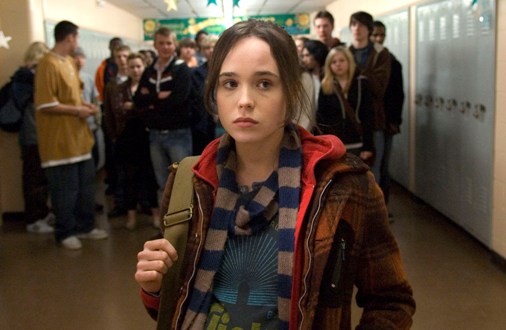
Juno feels the eyes on her at school
Rarely in recent film memory has a movie proved so much fun and combined that sense of joy with characters that you grow to love and care for like a lifelong friend. Juno, directed by Jason Reitman, is a wonderful film because of the evolution of the characters and of the narrative. As Roger Ebert commented on his review of the film "it begins with the pacing of a screwball comedy and ends as a portrait of characters we have come to love."
Juno tells the story of a 16 year old highschool girl named Juno MacGuff (Ellon Page) who upon choosing her close friend Paulie (Michael Cero) as her first sexual partner, falls pregnant. After informing her best friend Leah (Olivia Thirlby) of her unwanted medical condition, Juno decides that abortion is the best choice of action. "I'm going to go to Women Now, just cause they help out women now." informs Juno. It's a throw away line but one that sums up the film and the screenplay written by then unknown writer Diablo Cody. The film is full of brilliantly witty one liners and razor sharp observations. Some critics argued that teenagers don't actually speak like this. I can 100% confirm they do. When we're young we don't have the kind of filter on our language that we do when we grow up. We want people to know we are insightful and funny. Juno is both of those things.
On her way into Woman Now, Juno has an encounter with an anti abortion protester and fellow highschool student. She informs Juno that even in the womb, babies have fingernails. This new piece of information seems to throw Juno. There is a real life person inside her. Minutes later she is running out of the abortion surgery and into the Pennysaver ads. Adoption is her decision and Vanessa (Jennifer Garner) & Mark (Jason Bateman) are the parents to be. Vanessa, the warm hearted, natural born mother, Mark the cool guy, failed musicians who still has dreams of making it big. They seem the perfect couple. Later we find out that's not the case.
Before Juno meets up with the adoptive parents though, she has to tell her parents. In many films about teenagers and pregnancy, the parents are two dimensional. Not here. Rather than having a father who shouts at her or tries to kill the boy who knocked her up, her dad (J.K. Simmons) responds with " I didn't think he had it in him.". Later when the parents are talking alone, her step mum (Allison Janney) knows this wasn't a case of a pushy boyfriend trying to force sex on Juno "You know, of course, it wasn't his idea."
Juno grows ever larger as the film goes on. Her relationship with Paulie becomes more difficult. He likes her, she is confused and scared about her feelings for him. There is a connection there that Juno is scared to admit to. She might be having his baby, but she isn't ready yet to give into her feelings for him.
Meanwhile the parents to be are having problems of their own. While Vanessa worries about what shade of yellow to paint the babies room, Mark worries that he is not ready to be a dad. Is he really about to give up his dream of being a musician? For him, that part of his life isn't over and in a beautifully observed scene where he and Juno are dancing (and perhaps becoming a little bit too close without ever actually doing or saying anything inappropriate) he admits to her that he is going to leave Vanessa.
The film plays out beautifully and by the end you have grown to love the characters you see before you. Jennifer Garner in particular gives a heartbreaking performance of a mother to be waiting for a child of her own. She conveys such sadness when she puts her head to Juno's stomach to hear the baby kick only to be rewarded with no sound. You believe that this is a woman desperate for that connection that only comes with being a parent.
All throughout the film, music plays a large part of telling the story and connecting characters. There are two very different musical scenes involving Juno and Paulie that play out at the end of the film. The first one uses Cat Power's cover of Sea of Love (originally by Phil Phillips) as Juno lays in bed crying after the birth, being cuddled by Paulie. The music fits the scene beautifully and established the film as a true classic. It can be very hard for comedies to get the line between funny and serious right. The fact the film transforms these characters before your eyes without you ever noticing should not be underestimated. You'd have to have a heart of stone not to feel something watching Paulie comfort the girl he loves as she cries in his arms.
The second of these musical scenes is the final one of the film. It involves Juno and Paulie sitting on the steps of his house. They are together and they are happy. Juno is a film that is sweet, funny, beautiful, sad and joyful in equal measures. In 2007 Diablo Cody and Jason Reitman created not only of the most original female characters in recent film history but also a rare film that will appeal to a universal audience. This is no more just a film for teenagers than The Artist is a film for old people or Toy Story is for small kids. Juno will continue to live on because it's unique.
I remember the first time I saw it. I was surprised by just how touching it was and how well drawn the characters were. I wasn't expecting that. The film is a lot fun but it's so much more than just a comedy. I have no doubt that people will keep coming back to this film year after year, I'm also positive that it will continue to draw in new generations of fans in the decades to come. It's very easy to drown in the sea of love that is Juno.
"Nothing happens in it." "There's no story." "It's just Bill Murray walking around for two hours."
These are just some of the statements I've heard from people when discussing Lost in Translation. I have a lot of friends and acquaintances who love film and TV just as much as I do. Some are sci-fi geeks. Some love action. Others love comedy. For a lot of these people, Lost in Translation is a nothing film. Well I don't care what they say, I love it and I'm not alone.
A quick look at Rotten Tomatoes and you'll see that it was one of the highest ranking films of that year for critics. Is it just a critics film? Is it stuck up and snobby? Is it just for people who like to use films to look down at people? I honestly don't think it is.
The film revolves around two lost souls in the alien city of Tokyo. Bob (Bill Murray) is being handsomely paid to shoot a whiskey commercial but he'd rather be doing a play or something more worthwhile. His wife is at home with the kids. She sends him carpet samples for him to look over as he sits alone in his hotel room. Charlotte (Scarlet Johansson) has recently married a photographer and she has accompanied him to Tokyo while he shoots a band. She knows virtually no one there and her husband doesn't seem to want her around his work. Both Bob and Charlotte are stuck. In their lives and in their marriages.
This sets up the basic principle of the film. Upon their chance meeting in an elevator (he notices her, she doesn't notice him) and then again at the bar of the hotel, the loneliness of their lives and of the surrounding city soon draws them closer. But non in a sexual way. That is not what their relationship is about. They can be intimate. They can share a look, or hold hands but it's not about sex. It's a connection between two lonely people. Somehow they feel they can share more with a stranger than they can with a spouse.
Much of the film revolves around their relationship over the short time they spend together. From singing karaoke to a visit to the hospital. But to simply to describe what happens in the film is to miss the point entirely. This isn't a film about plot, it is a mood piece that relies on the subtlety of the actors. The smallest of glances they make can say more about the characters than 20 pages of rip roaring dialogue in a Tarintino film. Bill Murray does more than simply play a character similar to his own persona in real life. He creates a whole new life that looks like it has fully lived its 50 plus years on this earth. We are not seeing a character in a film, we are seeing a few days in the life of a real person with a real life outside of this motion picture. Or so it seems, such is the quality of Murray's acting.
Sofia Coppola wrote and directed Lost in Translation for which she won the Academy Award for Best Original Screenplay. There are moments in the film where you can't imagine the scenes could have existed if she didn't have the actors around her that she did. Would the film have worked as well if Bill Murray wasn't in it? No it wouldn't. But that's not to detract from her creation. She did after all create this world for both actors to play in. One memorable scene in the film is after Bob and Charlotte have had a fight. Well not so much a fight. There was no raised voices, just disappointing looks. The next morning as they sit in near silence in the restaurant, Charlotte makes a quip aimed at Bob for actions the night before. Bob's response is cutting.
"Wasn't there anybody else to lavish attention on you?"
The final scene between the two was not originally in the screenplay. Instead Bill Murray suggested the scene to Sofia. It was a simple scene but one that stole the show. Bob is the on the way to the airport. As his car is driving along he spots Charlotte in a crowd on the street. He gets out the car, makes his way over to her and they embrace. A hug, not a kiss. The film never set out to make these people fall in love and the avoidance of the kiss is key. It would have betrayed what goes before it if those two were forced into a fake romantic embrace. Instead we get two lonely characters hugging and sharing something. What they share, we don't know. It's not our place to know. Bob whispers in her ear but the camera doesn't pick it up. It's left up to us to imagine for ourselves what was said. It's just another reason why I love the film.
It would have been so easy to have these two characters spill their guts and have them have a big romantic moment where they describe their love one another. But they never do. Yes there is a small kiss at the end of the scene, but it's not romantic. Or at least not to me it isn't. It's two souls saying goodbye. I'll allow the film that.
Every time I watch the film, as "Just Like Honey" by The Jesus & Mairy Chain plays as the characters drift apart for one last final time, I'm left with the same feeling I had the first time I watched the film. I am content. This film soothes me in a way no other film does. I put it on when I need to think or when I just want to say hello to two of my favourite characters in recent film memory. It doesn't bother me in the slightest that some people don't get the film. I do and that's all that matters. Of course it's always nice when your opinion is shared by others. Thankfully on this film, Roger Ebert and I see eye to eye.
I don't always agree with Mr Ebert, but I always respect him. He can make valid points of criticism or praise that I might not agree with, but that are at least worth thinking about. In his reviews of Lost in Translation (linked below) he comes as close to anyone as ever done in disproving my theory that reviews themselves can't be art. Here's a man who loves this film as much as I do. And we don't care if you don't like it.